

When demand is variable and information is incomplete, the ability to predict what will happen is essential for making timely decisions, allocating resources efficiently, and reducing operational risks.
This is especially critical in the emergency room, where accesses are heterogeneous and fluctuate rapidly. Here, decisions such as admission vs. discharge must be made under time pressure (congestion, resource availability, bed constraints). In the absence of robust predictive tools, these choices may be hasty or inconsistent, with effects such as prolonged stays and “boarding,” delays or errors in the diagnostic pathway, increased clinical-operative risk, and suboptimal use of resources (avoidable hospitalizations or “fragile” discharges leading to new admissions).
This requires a data-driven approach that supports forecasting the risk of admission/re-admission after a return to the PS, improving both quality of care and operational efficiency.
The implementation was developed in a large hub emergency department with daily accesses close to 200 patients.
Methodological approach
Step 1 – Multivariate analysis with interpretable models
Use of interpretable models to understand which factors most affect new admissions after a return to the ER.
Step 2 – Selection of the most accurate predictive models
Implementation and comparison of a portfolio of machine learning models (e.g., Random Forest and Gradient Boosting) to estimate the probability of hospitalization following a new visit to the PS.
Results
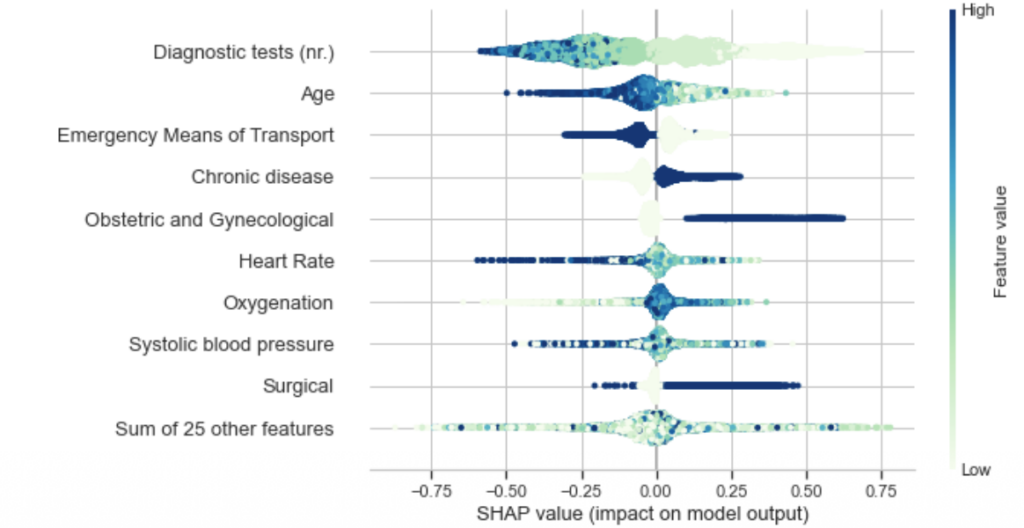
Key insights
Higher likelihood of hospitalization after new admission to the PS for people with chronic conditions, younger age, and foreign nationality. Certain clinical signs (vital signs) and arrival by emergency means appear to be associated with a lower likelihood of subsequent hospitalization
Prediction performance
Machine learning models, especially Gradient Boosting, have outperformed traditional approaches (logit model), achieving about 80% recall and precision, thus more reliable predictions.
More proactive decisions, better efficiency
The integration of historical data and information available in real time supports SP managers in making more informed and timely decisions, improving both quality of care and operational efficiency.